Semaglutide research, with the trial attached
Weight, blood sugar, heart events and kidney events occupy different plates. I resist piling them into one promise.
SELECT enlarged the question
I arrived expecting the weight trials to dominate this shelf. SELECT's cardiovascular result gave me a stronger reason to stay. Its 17,604 participants had established cardiovascular disease and overweight or obesity, but no diabetes. The study used once-weekly semaglutide 2.4 mg and counted cardiovascular death, nonfatal heart attack and nonfatal stroke.
The composite outcome was reduced by 20% relative to placebo: HR 0.80, with a 95% confidence interval of 0.72–0.90. A hazard ratio compares event rates over follow-up; the percentage of participants who escaped an event is a different measure. In my judgment, a result about serious events deserves at least as much prominence as a result about the scale.
It is still a result in that particular population, using that preparation. The oral tablet's evidence is substantial on its own terms; SELECT tested the injection.
Semaglutide weight loss was measured in a large study
Semaglutide weight loss has been measured in some of the largest obesity trials ever run. In STEP 1 (n=1,961 adults with overweight or obesity, no diabetes), the once-weekly 2.4 mg injection produced a mean body-weight change of -14.9% from baseline to week 68, versus -2.4% on placebo — a treatment difference of about 12.4 percentage points [1].
The weight effect carries over into hard outcomes. In SELECT (n=17,604), in adults with established cardiovascular disease and overweight/obesity but no diabetes, the same 2.4 mg weekly dose cut the composite of cardiovascular death, nonfatal heart attack, and nonfatal stroke by 20% (HR 0.80; 95% CI 0.72-0.90; P<0.001) [3]. And the oral route delivers weight loss too: in the OASIS program, once-daily oral semaglutide at 50 mg produced clinically meaningful weight loss versus placebo in adults with overweight or obesity without diabetes [9].
Study averages don't decide who receives care. Promise Peptides has begun prescribing semaglutide at its U.S. telehealth service, mypromise.com. A licensed U.S. clinician considers each person's history and request; some requests end without a prescription. The service considers U.S. patients only, with options shaped by the state and the proposed treatment. Semaglutide also comes in FDA-approved products; compounded medicine has no FDA approval.
One honest caveat the research carries: weight comes back after stopping (the STEP 1 extension saw a mean regain of about 11.6 percentage points within a year) [1], which is why the literature frames this as a chronic therapy rather than a cure.
The heart result and the eye signal share a paper
SUSTAIN-6 enrolled 3,297 people with type 2 diabetes at high cardiovascular risk. With once-weekly semaglutide 0.5 or 1.0 mg, the composite of cardiovascular death, nonfatal heart attack or nonfatal stroke favored semaglutide: HR 0.74; 95% confidence interval 0.58–0.95.
The same paper reported more diabetic-retinopathy complications: HR 1.76; 95% confidence interval 1.11–2.78. The signal was concentrated among people with pre-existing eye damage undergoing a rapid fall in blood sugar. The safety review discusses early worsening with rapid glucose correction as a possible explanation, rather than treating direct retinal toxicity as established.
A summary that borrows the cardiovascular result and leaves the eye result behind frustrates me. They were not written by different molecules. Both are findings from this trial.
FLOW asked about kidneys already at risk
FLOW studied 3,533 people with type 2 diabetes and chronic kidney disease. Once-weekly semaglutide 1.0 mg reduced its composite of kidney failure, a decline of at least 50% in estimated kidney filtration, or death from kidney or cardiovascular causes. The hazard ratio was 0.76; the 95% confidence interval was 0.66–0.88, corresponding to a 24% lower risk versus placebo.
The outcome is broader than “kidney failure” alone. That distinction matters when a headline compresses it. A related cardiovascular analysis across kidney-disease severity reported consistent benefit across the severity groups. To me, the severity analysis clarifies FLOW; it does not justify dropping diabetes or chronic kidney disease from the description of who was studied.
Semaglutide vs tirzepatide finally shares a frame
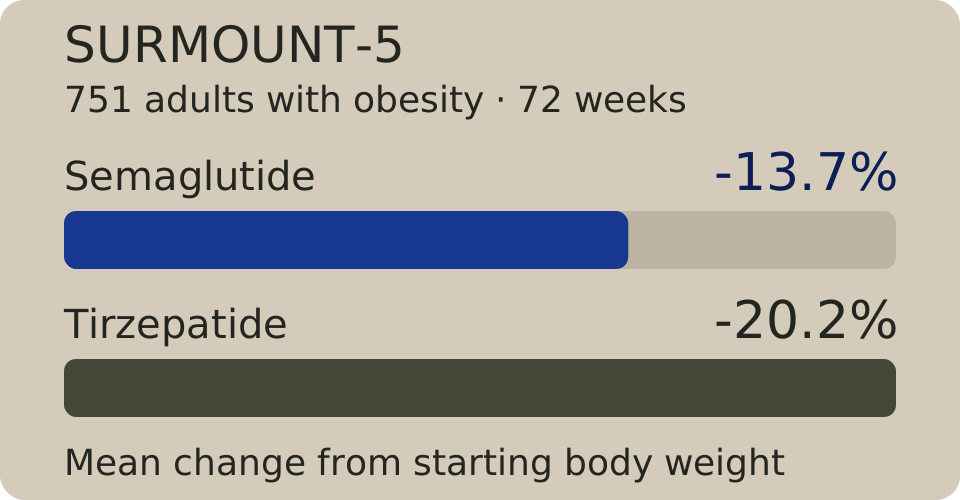
SURMOUNT-5 compared the drugs directly in 751 adults with obesity. At 72 weeks, mean weight change was -13.7% with semaglutide and -20.2% with tirzepatide; the difference was statistically significant, P<0.001. A minus sign means weight fell.
Semaglutide activates the GLP-1 receptor; tirzepatide activates both GIP and GLP-1 receptors. That difference is biologically interesting, but the comparison's virtue is simpler: the two drugs were tested inside the same trial. I trust this frame for their weight comparison more than a contest assembled from unrelated study averages.
The larger average loss does not decide which treatment fits a person, and it does not answer every heart, kidney or safety question. It answers the weight question SURMOUNT-5 posed.
The appetite mechanism has an animal trail
How does semaglutide work? The clinical outcomes do not, by themselves, map the brain. Gabery and colleagues studied semaglutide in mice and rats, tracing access to appetite-related regions and finding reduced food intake and altered food preference without a decrease in energy expenditure. This was rodent evidence.
Earlier arcuate-nucleus work in mice used liraglutide, a different GLP-1 medicine. Later rodent work examined appetite-neuron activity at different times and metabolic states. I value these studies as attempts to explain the clinical story, but borrowing an animal circuit and calling it a complete account of human hunger would make the explanation too neat.
The semaglutide peptide preserves a resemblance, not a lifespan
The semaglutide peptide is a 31-amino-acid chain with about 94% sequence similarity to native GLP-1. Resistance to breakdown and albumin binding give the analogue its prolonged residence, as described in the safety review. Those structural figures quantify the molecule's makeup; a person's chance of benefit is a separate question.
The preparation story returns here. The tablet solves an entrance problem; the long half-life reflects the altered molecule. The trials test what happens when both the molecule and its preparation reach people. None of those layers is dispensable.