Oral Semaglutide: a tablet against the stomach
The pill is an answer to a chemical obstacle. Calling it convenient leaves out the obstacle.
An unpromising place to put a peptide
The stomach is a difficult entrance for a medicine made from a peptide chain. Semaglutide can be broken apart there before it crosses the lining. I had assumed that the tablet mainly changed the delivery device. The formulation review persuaded me to take the ingredients around the molecule just as seriously as the molecule itself.
SNAC is the tablet's absorption enhancer. It temporarily raises local gastric pH, making the immediate surroundings less acidic, and helps individual semaglutide molecules cross the stomach lining. The word “local” does useful work here: the formulation creates a brief opportunity near the tablet. It does not abolish digestion.
Even with SNAC, oral bioavailability is about 0.4–1%. That is a small fraction of the swallowed amount. I regard the tablet as a clever accommodation with the stomach, rather than a victory over it.
The helper ingredient deserves its place on the bench
SNAC rarely gets the fame, but without the absorption-enhancing formulation this would be a different story. Food, drink and other oral medicines can change the conditions in which that small share gets through. The approved tablet's fasting requirement and limited-water conditions reflect this dependence.
I dislike the shorthand “just a pill” here. An injection makes its own demands; the tablet exchanges the needle for constraints around the stomach. That is a genuine change, but judging convenience requires the circumstances of daily life. None of those label conditions is offered here as an administration plan.

The same entrance fee buys very different amounts
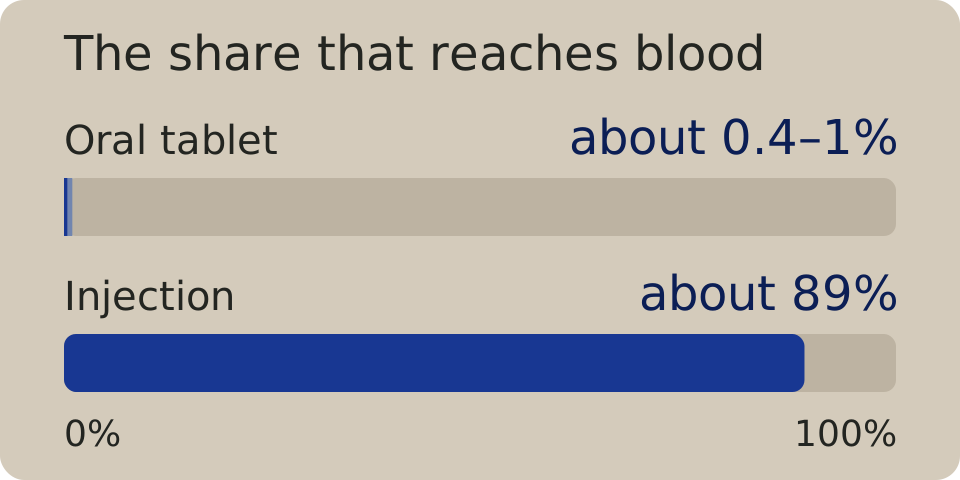
Here is the numerical reason to resist a milligram-for-milligram comparison. The oral absorption review puts the tablet's absorbed share at about 0.4–1%; the injection's share is about 89%. “Amount swallowed” and “amount reaching blood” are not interchangeable quantities.
This plate gives both shares the same scale. It says nothing about equal doses, equal blood concentrations or equal outcomes. Once semaglutide has arrived in the blood, both forms have an elimination half-life of about one week. Entry and exit are separate problems.
The semaglutide injection has a different trial shelf
The semaglutide injection placed medicine under the skin rather than through the stomach. It was the form used in STEP 1 for weight management, SUSTAIN-6 for cardiovascular outcomes in diabetes, SELECT for cardiovascular outcomes without diabetes and FLOW for kidney outcomes in diabetes.
That shelf is substantial. It does not establish that every result on it can be assigned to the tablet, nor that an injection is the right form for a particular person. A trial name earns its place in my catalogue only with its preparation and population still attached. Otherwise, every result becomes an attribute of “semaglutide” in the abstract.